
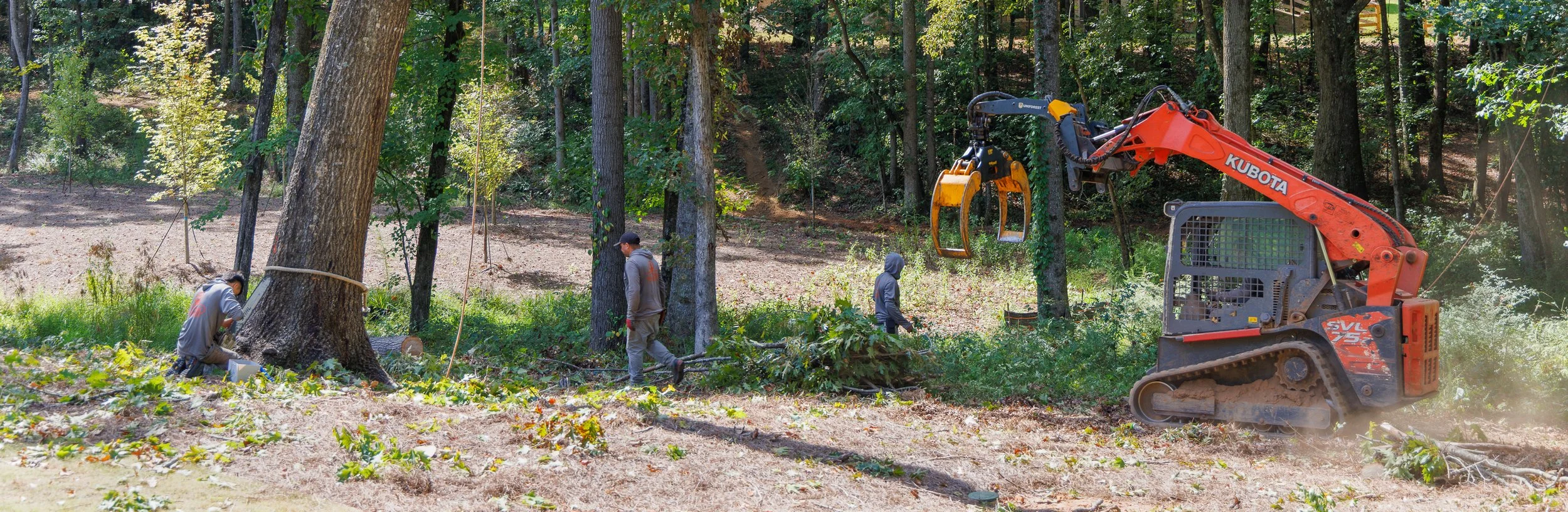
You hear the chainsaws next door. A few hours later, the tree that has been part of your view for years is gone.
Then you look at your own yard.
Wait...now my tree is the tallest one standing. Should I be worried?
It's a question North Georgia homeowners may not think about until a neighboring tree comes down.
Trees don't grow in isolation. In wooded neighborhoods throughout Cumming, Forsyth County, Alpharetta, Milton, Dawsonville, Gainesville, Lake Lanier, and surrounding North Georgia communities, mature trees often grow together for decades. Their surroundings influence how they're exposed to sunlight, wind, rain, and changing weather.
When one or several nearby trees are removed, the remaining trees suddenly have different surroundings. That does not mean your tree is going to fall.
But it does give you a good reason to look at your property with fresh eyes.
At LS Trees, we've spent more than 15 years working with North Georgia homeowners on tree assessments, trimming, tree removal, stump grinding, and storm cleanup. Here's what homeowners should know when the landscape next door suddenly changes.
Can Removing One Tree Make Another Tree More Likely to Fall?
Not automatically. A healthy, structurally sound tree doesn't suddenly become dangerous simply because the tree beside it was removed.
However, removing nearby trees can change the wind and weather exposure experienced by the trees that remain.
Imagine three mature trees standing together.
For years, surrounding canopies and trunks have influenced how wind moves through that area. Remove one or two, and a remaining tree may become more directly exposed to wind than it was previously.
That's particularly worth noticing if the remaining tree already has other concerns, such as:
Dead or damaged limbs
Significant cracks or splits
Previous storm damage
A changing lean
Root damage or exposed roots
Soil movement around the base
Cavities or areas of decay
An unbalanced canopy
Recent construction or excavation nearby
The important distinction is this: The neighboring removal isn't necessarily the problem. It may simply change the conditions around a tree that was already there.
“My Tree Is Now the Tallest One Standing.” Is That Dangerous?
Height alone doesn't make a tree dangerous. A tall pine, oak, poplar, or other mature tree can remain part of a property for many years.
But if your tree was previously surrounded by equally tall trees and is now considerably more exposed, it's reasonable to start paying closer attention to it.
Ask yourself: Has anything about the tree itself changed?
Don't just look at its height. Look at the trunk, canopy, roots, soil, and overall structure.
If everything appears the same, that's useful information. If something looks different, especially after the neighboring work or following severe weather, consider having it evaluated.
Look Up: Has the Canopy Changed?
Start your inspection at the top.
Look for:
Broken or hanging branches
Large dead limbs
Significant areas without foliage during the growing season
Branches crossing or rubbing
New damage
Limbs extending toward your home, driveway, garage, barn, or other structures
A tree that suddenly has more exposure to wind isn't necessarily a tree that needs to be removed.
In some situations, professional tree trimming or pruning may be appropriate to address specific damaged or problematic limbs.
Avoid aggressively removing branches simply because you're concerned about wind. Excessive or improper pruning can create additional problems rather than solve them.
Look Down: What's Happening Around the Roots?
Homeowners naturally look up when they're worried about a tree.
Don't forget to look down. Roots are a major part of the tree's support system, and changes around the base can provide important clues.
Walk around the tree and look for:
Newly exposed roots
Broken or damaged roots
Soil lifting or heaving
New cracks in the soil
Significant erosion
Standing water or drainage changes
Recent excavation near the tree
This becomes especially relevant when the neighboring tree removal involved equipment, digging, grading, construction, or other work close to your property line.
Roots don't stop growing simply because they reach a property boundary.
What If My Neighbor's Tree Roots Cross Into My Yard?
This is where things can become more complicated.
Large trees can have root systems extending well beyond what homeowners see above ground. Work performed on one property can sometimes occur near roots associated with trees on another property.
That doesn't mean nearby tree removal necessarily damaged your tree's roots.
It means that if substantial digging, trenching, grading, or excavation happened near a mature tree on your property and you later notice changes, don't ignore them.
Document what you see and consider getting a professional opinion.
What If Removing Their Tree Exposes Mine to More Sun?
Wind isn't the only thing that can change.
Your tree may suddenly receive considerably more direct sunlight. That can alter the growing conditions around portions of the tree and surrounding landscape.
Again, change does not equal danger. But it's another reason we encourage homeowners to observe rather than immediately react.
Take photographs of the tree now. Then compare them periodically.
Photos make it much easier to answer questions such as:
Was that branch always there?
Has the canopy changed?
Was the tree leaning that much before?
Has that crack gotten larger?
Were those roots always exposed?
Your phone can become a surprisingly useful tree-monitoring tool.
What If Several Trees Were Removed at Once?
This deserves a little more attention.
There's a difference between your neighbor removing one ornamental tree and clearing a significant portion of a wooded lot beside your property.
When multiple mature trees are removed, the environment surrounding the remaining trees can change more noticeably.
Trees that were once located deeper within a wooded area may become more exposed along a newly created edge.
If significant clearing has occurred beside your property, walk the new tree line and look at the trees that are now most exposed.
You aren't looking for an excuse to remove them. You're establishing a new baseline.
Photograph them. Look at their trunks and roots. Note existing damage. Then you'll be much better positioned to notice if something changes later.
Don't Remove Your Tree Just Because Your Neighbor Removed Theirs
This is important. 👇
Seeing tree removal next door can make homeowners nervous, especially if their own trees are large.
But: Your neighbor's decision isn't automatically the right decision for your property.
Their tree may have had internal decay. It may have interfered with construction. It may have suffered storm damage. It may simply have been located somewhere they no longer wanted it. You may not know why it was removed.
Before deciding that your tree should come down too, evaluate your tree based on its own condition and surroundings.
At LS Trees, we believe good tree care isn't about cutting down the most trees. It's about making the right decision for the tree and the property.
Sometimes that means removal. Sometimes it means trimming. Sometimes it means keeping an eye on something. And sometimes the recommendation may simply be to leave the tree alone.
What If the Tree Is Directly on the Property Line?
Property-line trees can introduce questions that go beyond tree health.
Before authorizing work on a tree that may be shared with a neighbor, determine where the property boundary actually lies and who owns the tree.
Don't rely solely on where a fence happens to be located or where you assume the property line falls.
If ownership is unclear, it may be worth consulting your survey or getting appropriate professional guidance before authorizing major work.
Tree companies can evaluate trees and perform tree work, but property ownership disputes are legal matters, not tree-care decisions.
Your Neighbor's Tree Came Down During a Storm. Should You Check Yours?
Yes, this is a particularly good time to walk your property. If a storm was strong enough to bring down a nearby tree, inspect yours afterward. Look for changes rather than simply asking whether the tree is still standing.
You may notice:
Freshly broken limbs
Hanging branches
New cracks
Bark damage
A changed lean
Root movement
Soil lifting
Damage caused by another tree or branch striking yours
A tree can survive a storm and still sustain damage worth evaluating. If you see a tree contacting a power line or a downed line nearby, stay away and contact the appropriate utility or emergency service rather than approaching it yourself.
Tree Removal vs. Tree Trimming: Which Does Your Tree Need?
This is one of the most common decisions homeowners face. There isn't a universal answer.
Tree trimming may be appropriate when:
Specific branches are dead, damaged, broken, interfering with structures, or otherwise need attention while the overall tree remains suitable to retain.
Tree removal may be considered when:
The tree has significant structural problems, extensive decline or damage, unacceptable conflicts with its surroundings, or other circumstances where retaining it is no longer the preferred option.
Monitoring may make sense when:
There isn't currently a reason for immediate work, but a homeowner wants to keep an eye on an existing condition or recent environmental change.
That's why having someone look at the actual tree is much more useful than trying to make a decision based solely on height, species, or what happened next door.
Should You Get a Tree Assessment After Your Neighbor Removes Trees?
You don't necessarily need to call a tree company every time someone in the neighborhood removes a tree.
But an assessment may make sense if:
Several large trees next door were removed
Your trees are now significantly more exposed
You notice new damage or changes
Excavation occurred close to your trees
You're concerned about a large tree near your home
A recent storm affected the area
You're simply unsure whether what you're seeing is normal
Sometimes reassurance is the solution.
Knowing that a tree doesn't currently need removal can be just as valuable as knowing when one does.
Heading Into Winter? This Is a Good Time to Establish a Baseline
November is a particularly useful time for North Georgia homeowners to start paying attention to their trees.
As leaves fall from many deciduous species, portions of the tree's branching structure can become easier to observe from the ground. It's also a natural time to walk the property before winter weather, holiday guests, and the beginning of another year.
If your neighbor recently removed trees, take a few pictures of yours now. Then you'll have something to compare after winter storms, heavy rain, high winds, or next year's growing season.
Frequently Asked Questions About Neighboring Tree Removal
Can my neighbor removing a tree make mine fall?
Not necessarily. Tree stability depends on many factors, including the individual tree's condition, roots, structure, soil, surroundings, and weather exposure. Nearby tree removal may change the environment around your tree, but it does not automatically make the remaining tree unsafe.
Should I remove my tree because it is now the tallest one?
No. Height alone isn't a reason to remove a tree. If you're concerned because the tree is newly exposed, evaluate its overall condition rather than assuming it needs removal.
Can removing nearby trees change wind exposure?
It can. Surrounding trees and vegetation influence how wind moves through an area. Removing trees may leave remaining trees more directly exposed, particularly along newly created wooded edges.
Should I trim a newly exposed tree?
Don't automatically prune a tree simply because nearby trees were removed. The appropriate pruning depends on the individual tree and the reason for the work. Improper or excessive pruning isn't a substitute for professional evaluation.
What should I do if I notice my tree leaning after work next door?
A new or noticeably increasing lean deserves attention, particularly if you also see root movement, soil cracking, or other changes around the base. Avoid working underneath or around a tree you believe may be unstable and seek professional evaluation.
Can LS Trees look at my tree without removing it?
Absolutely. Calling LS Trees doesn't commit you to tree removal. We can look at the tree and property and discuss whether trimming, removal, monitoring, or no immediate work appears appropriate.
Professional Tree Assessments in Cumming, GA & North Georgia
When the landscape around your home changes, it's natural to start looking differently at your own trees. But don't let the sound of your neighbor's chainsaw convince you that yours needs to come down too.
Look first. Compare. Ask questions. Then make an informed decision.
LS Trees brings 15+ years of experience to tree care throughout Cumming, Forsyth County, Alpharetta, Milton, Dawsonville, Gainesville, Lake Lanier, and surrounding North Georgia communities.
Our services include:
Tree assessments
Tree trimming and pruning
Tree removal
Stump grinding
Storm cleanup
Emergency tree services
If your neighbor recently removed trees and you're now looking at yours thinking, “Should I be worried about that?”, you don't have to guess.
📞 Call LS Trees at (770) 616-6079 for a free estimate or tree assessment. Sometimes the best tree service is knowing you don't need one yet. 🌳